
Ellen Chang-Richardson is an award-winning poet of Taiwanese and Chinese Cambodian descent whose multi-genre writing has appeared in Augur, The Fiddlehead, Grain, Plenitude, Watch Your Head: Writers and Artists Respond to the Climate Crisis, The Spirits Have Nothing to Do with Us: New Chinese Canadian Fiction and others. The co-founder of Riverbed Reading Series, they are a member of Room’s editorial collective, long con magazine’s editorial board and the creative poetry collective VII. They are represented by Tasneem Motala at the Rights Factory and currently live on the traditional unceded territory of the Algonquin Nation (Ottawa, Canada).
Below are excerpts from the interview with James Morehead on the Viewless Wings Poetry Podcast.
James: The poems in “Blood Belies” are striking, visually, from the first page. Your poetry is such a visceral example of what makes the poetic form unique, giving blank space a voice. What were your influences as you developed this style?


Ellen: “First off, thank you for this question. I love answering these, especially when readers are aware of the page and the space, and what it lends to the poetic form. It really harkens back to my training as a visual artist. I view the page as a canvas, and through that lens, I arrange words, grammatical points, markings—as I call them—in a way that suits not just the context but also the way one would read the piece and engage with it visually.”
James: I’ve interviewed several poets who use poetry to bring histories to life in a way that few history textbooks accomplish. The history of the Chinese-Canadian diaspora is told in different ways throughout the collection, and most powerfully in “urban facts 2.0” which you’ll read later. How do you approach which details to include when crafting a poem grounded in history?
Ellen: “I’ll speak directly to ‘urban facts 2.0’. There are about 14 pivotal dates in the poem. I used pivotal dates in the history of Chinese immigration into Canada as well as more recent pivotal moments of memory, moments when either myself or my friends who look like me experienced racism on the streets of not just Canada, but also North America. It includes some moments in New York, which was always a riot. In that specific poem, that’s how I interact with this vast history and memory of the movements of people into this country.
“In a different poem, I interact with history through a historical text. There’s a piece in the center of the collection called ‘resonate this,’ and that specific piece was an intervention, as I like to call them, originally on the 1902 parliamentary paper. It was a sessional paper issued by the Parliament of Canada in 1902, number 54, on Chinese and Japanese immigration. In that specific piece, I use quotes from the text to ground it in history while braiding in my own personal experience and that of my friends and family.”
James: “resonate this*” employs multiple forms, free verse, concrete poetry, found poetry, micro-poetry, and sequences like Morse code that are strictly visual. An excerpt:
Iron hearts guard cold doors closed
but red on white, we
                                          are not your enemy…
How did this poem evolve and when intersecting so many forms into a long poem what was your approach to revision and editing?
Ellen: “This poem originally started in more of a traditional form. It was condensed to basically a maximum of two pages, all left-aligned, and it was really dense. The material is difficult to engage with—it’s difficult for readers to engage with, and it’s difficult for me to read, even though I’ve read it multiple times now in different reading settings. So, in editing it, I thought, ‘Okay, how can I give the reader a bit of breathing room, a bit of space to grapple with this really dark, uncomfortable information?’
“The page that comes directly after what you just quoted was lifted from a Canadian encyclopedia entry that came in after the Exclusion Act was enacted in Canada as a result of this paper. It says, ‘Chinese immigration suspended until further notice. Ethnic Chinese with British nationality also restricted.’ Now, Canada being a British settlement, that’s ironic. So it’s full of this heavy material, and I really just wanted to give the readers space to breathe. Maybe there’s an element of care there, because when you’re reading hard, uncomfortable, dark information, it’s important to give your soul some space.”
James: I think you make a really important point for people listening who are new to writing poetry: the form can play such a critical role. It gives the poem a chance to breathe, affects its pacing, and impacts how it strikes you visually before you even read a single word. Form is so important, and you may not know what the form is until you’re done. I think it’s a great example of that—you found the form of the poem after the fact, not as a plan going in, which is probably more typically the case.
Ellen: “Yeah, and there’s also an element of when poetry speaks back to you. Poets write poetry because it’s truth, and sometimes we go in knowing exactly how we want to portray that, but then other times the text speaks back, the text gives its own voice back. Later on in that poem, actually on pages 82 and 81, there’s a concrete part of the poem. There’s a tree, and beneath the shade of that tree is where five and a half Chinese children play. That part took forever to hammer out. Up until probably the tenth hour of editing, it was not like this. Something didn’t sit right with me. I kept thinking about it—I think it was aligned left on one page and right on the other page, but it didn’t quite have enough oomph, enough substance behind the words.
“I think I was in the shower, just ruminating over it, and all of a sudden this idea of creating a maple tree, or what looks like it could potentially be a maple tree, out of the text came to me. I was like, ‘Oh, that’s how this is going to go.’”
James: Nature, and a longing for the balance in the natural world, is infused into many of the poems. In “between branches” you wrote:
I want to dance but
not on the bones of migrants
visit the shades of my ancestors
in spaces between pine
and sky;
How do you approach infusing nature into your poetry?
Ellen: “I actually draw from readings of Indigenous texts. I’ve been trying to broaden my literary landscape over the last, I would say, half a decade, throughout the pandemic and into now. For Indigenous cultures, nature is a living, breathing thing. It’s not just something that we interact with; it’s something that interacts with us. It’s something that gifts something to us, guides us, and moves with humans and animals. It’s something deserving of respect.
“I love nature, but I also love the city. There’s a hard tension between what humans have done to nature and how we also depend on it so much in order to live and survive. I try to slide into the joints—if that makes any sense. I try to find the joints of which words I’ll use and what visuals I want to create. I want the reader to feel the poignancy but also the fineness of that balance between nature and the Anthropocene. It’s a very fine, gritty line.”
James: Canada is marketed for embracing immigration and multiculturalism, yet it has a very troubled history, including recent history, regarding its treatment of immigrants, migrants, and Indigenous peoples. What role should poets play in bringing histories like this to life?
Ellen: “I can’t speak for all poets. Each poet, just like every artist, has a different impulse towards why they create. I can speak to why I write the way I do and why I target and highlight the issues that I do. It’s really to shine a spotlight on what many others would prefer to sweep under the rug. It’s to talk about it, to open up those conversations, to shed light on the past but not in a way that leaves it stuck there.
“My hope is that it opens up a conversation so we can talk about it in the present day and move forward together. Maybe I’m too hopeful, but I believe we can move forward into a better future, one where we’re all working alongside each other to better ourselves and the communities we are part of.”
James: I think poetry can be very effective in doing that, better than a history book with just a bunch of dates that you’re supposed to memorize. Poetry can give you a starting point; it can catch you emotionally, and then you want to go research the details. The poem can’t and shouldn’t show you all the details, but if it hooks you and gets an emotional response, then you act. That’s something I’ve done with your book and other books that are rooted in history. When I’m intrigued by a poem, I want to go learn more. Poetry and art should be essential teaching tools in history classes.
Ellen: “Yes, I can’t remember exactly when—maybe half a year ago. My memory can barely remember last week. I was at some museum. You know the feeling when you’re walking into a museum? I remember this feeling. It was dark, it was cool, and I walked in and there were these video installations playing. It was a retrospective of an Indigenous artist’s work. It was through her work that I found out about uprisings in 1990, just outside of Oakville, Ontario, which is where I was raised. History books didn’t cover it, but like you, I fell into this rabbit hole of research. I was like, ‘What happened? What’s going on now?’ So yeah, I agree. I think poetry—and maybe arts in general, but poetry in particular—can play a crucial role.”
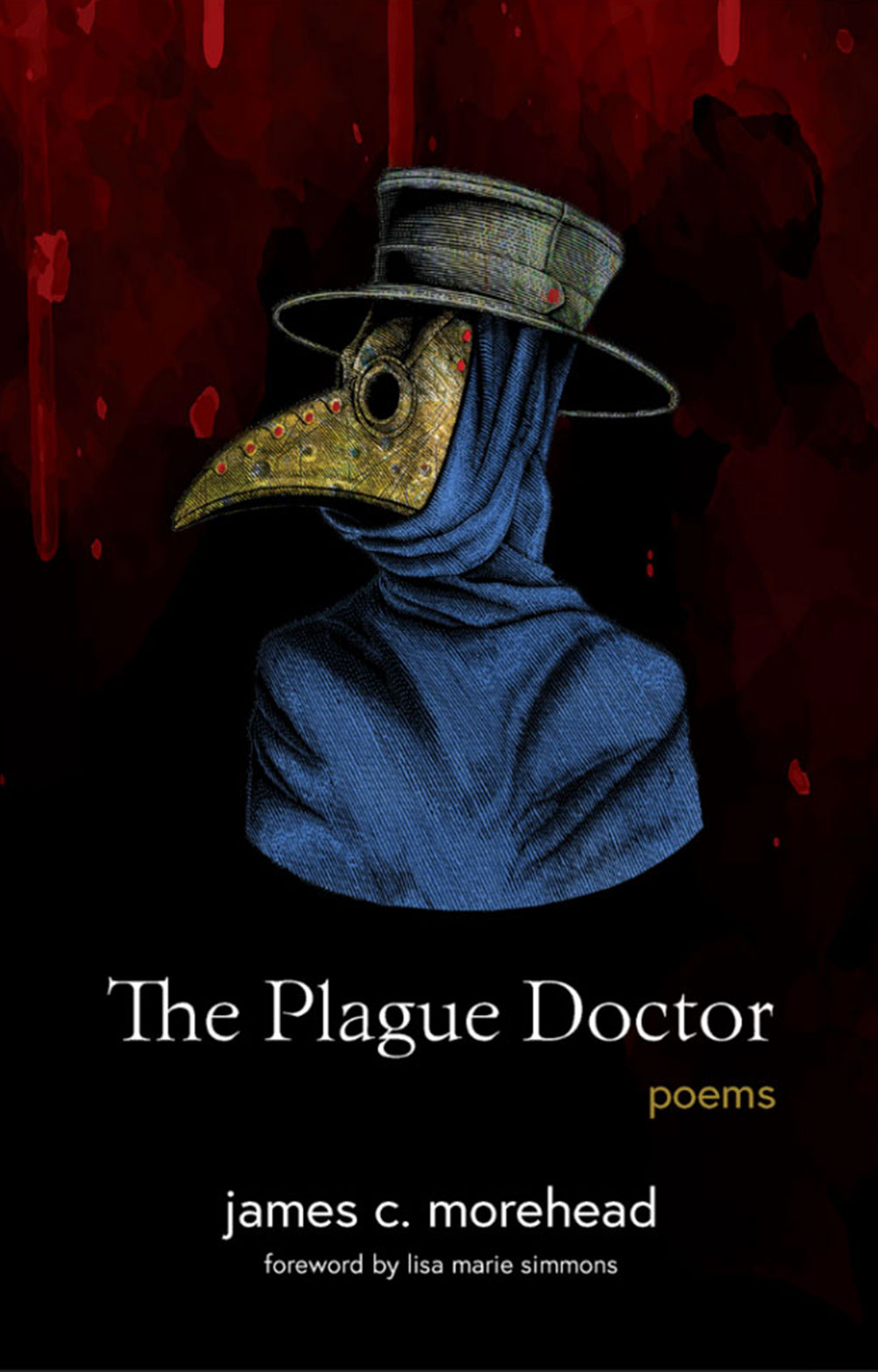
James: “Blood Belies” includes filtered photographs, iconography, and pages filled with black. In my most recent book, “The Plague Doctor,” the visual elements and design were as important to me as the poems. How did you approach editing the visual elements into this book?
Ellen: “I’d love to talk about this because I want to give a wholehearted shout-out to All Second Wind. My copy editor and book designer were fantastic about typesetting and placing everything exactly as I wanted. It did take a lot of work on my end as well. At the eleventh hour, I found out what my printable margins were and completely reformatted.
“So, note to the wise: find out your printable margins at the beginning of your project—very good practical advice. Outside of that, the only constraints I really had were that we could only print in black and white. I thought, ‘Okay, if we can only print in black and white, what can I do?’ My book designer, who is fantastic, took everything I put in Word, brought it over into InDesign, and we went back and forth multiple times to make sure it was exactly right. That’s the hallmark of a good publisher.”
James: I can relate to that element of it. Black and white is much more cost-effective, but it also changes the feel of the paper and the overall experience. In “The Plague Doctor,” I ended up changing photographs to make sure they would really work in black and white, even though they were taken in color. I didn’t want the trade-offs of a color book, where the paper and experience would be different.
Ellen: “Exactly! I went through the same process with the photographs. They were originally in color, but I converted them to black and white and made sure they were exactly what I wanted before giving them to the publisher. The page texture is also important. For those finalized copies of the book, the pages feel almost like parchment, which lends itself beautifully to the context of the book. Thank you for that question; I love talking about design.
“I also want to talk about what you call the Morse code poems. At the very beginning, there’s a poem that says: ‘Base notes hit the edge of the high.’
That poem runs as an undercurrent throughout the entire collection. It was originally written in response to the Canadian band BadBadNotGood, who work with experimental jazz and post-rock. I was listening to their albums BBNG2 and BBNG3, and the poem is a reaction to those pieces. During the editing phases, I realized that this mirrored what my brain experiences during post-concussion flare-ups.
“Everyone I’ve talked to who has had trauma to their brain resonates with this. When I read it, I have this wooden board that my friend made from a tree that fell on her property. She sanded it down and cut it to shape. it’s a beautiful piece of visual art as well as an instrument. I actually play those Morse code poems on this board.”
James: In the long poem “tundra mist” there is a striking spread with the left page visualized a lined paper and the words: “Asylum GRANTED // Status: Political // Refugee”, and the right page containing the line: “Yet the real story I am told is entirely different.” How did you get comfortable with poetry that is so slight on each page, where every letter and the placement of each word is so exposed?
Ellen: “I think I’m going to bring it back to when I first started writing poetry. I went to a lot of open mics because that’s how I became comfortable with sharing my work with the world and engaging with the literary community. I was in Toronto at the time, and one poet I saw on stage read a poem that was basically three lines. The essence was ‘poetry is exposing the layers until you hit bone.’
“That might be me paraphrasing what she actually said, but ‘until you hit bone’ is word for word what she said. I hold on to that concept. I believe that concept can be conveyed through sparse, precise language. If you’re going to throw a cliché on a page and leave it at that, it might be lacking. I choose to go sparse because if the vocabulary is precise, a lot can be conveyed and felt with very few words.”
Listen to the full interview on the Viewless Wings Poetry Podcast to hear Ellen recite their poetry.


![Poet A.E. Hines on Queer Eros, the Natural World, and his latest collection “Adam in the Garden” [INTERVIEW]](https://i0.wp.com/staging-9317-viewlesswingspress.wpcomstaging.com/wp-content/uploads/2024/07/Earl_headshot-1024x1024-1.jpg?fit=1024%2C1024&ssl=1)
![Olivia Gatwood on Crafting Her Stunning Novel “Whoever You Are, Honey” [INTERVIEW]](https://i0.wp.com/staging-9317-viewlesswingspress.wpcomstaging.com/wp-content/uploads/2024/07/OLIVIA-GATWOOD-08.09.23-MICHAEL-DRUMMOND-1064-1-683x1024-1.jpg?fit=683%2C1024&ssl=1)
![Lauren Ducrey Brings the Power of Poetry into Corporate Workshops [INTERVIEW]](https://i0.wp.com/staging-9317-viewlesswingspress.wpcomstaging.com/wp-content/uploads/2024/04/LD102022-15.jpeg?fit=7952%2C5304&ssl=1)
0 Comments